
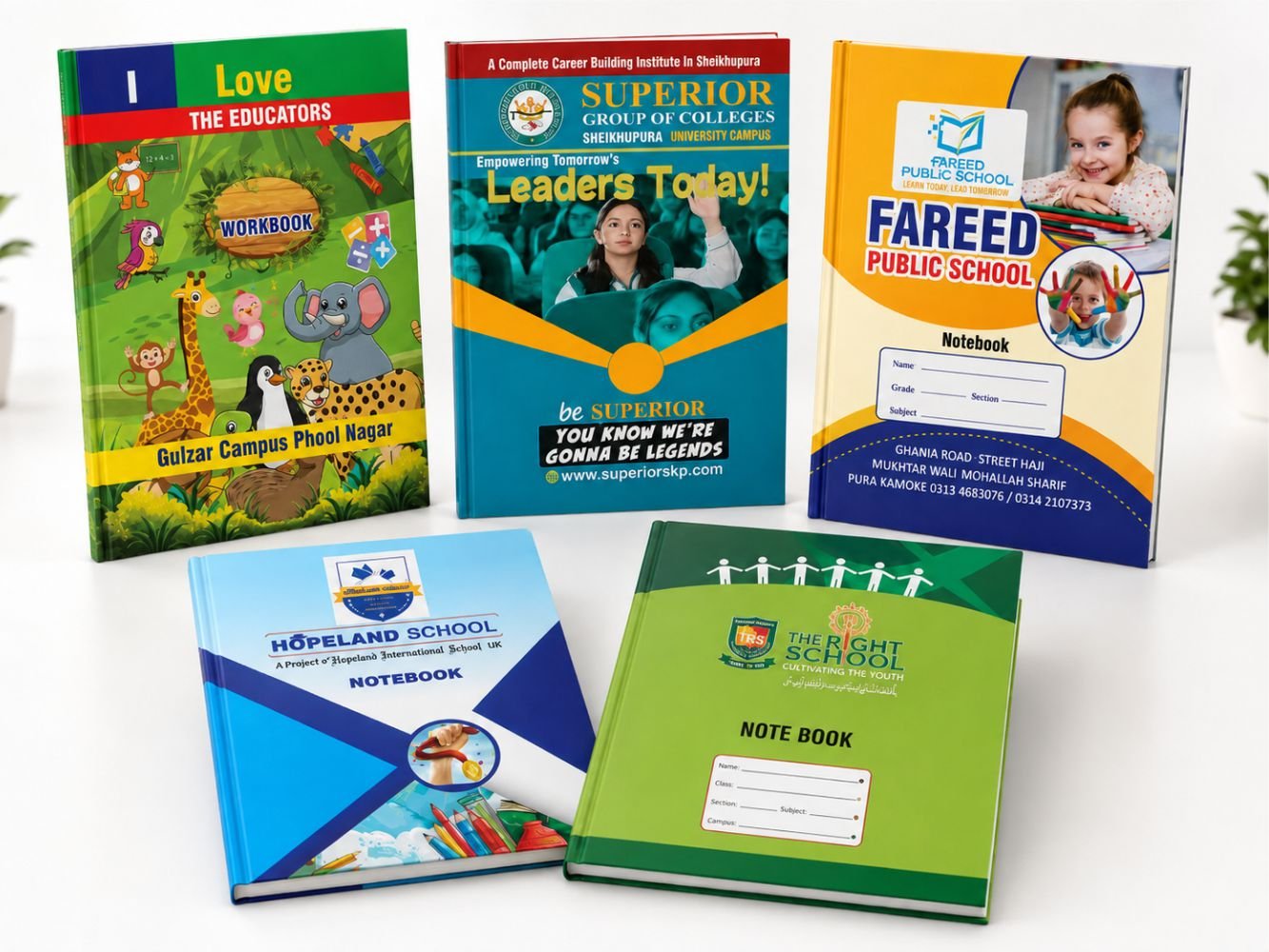
How Many Notebooks Should I Buy for Primary School? A Complete Guide for Parents & Schools
How Many Notebooks for Primary School? Classes 1–5 Guide
How many notebooks should I buy for primary school? Before a new academic session, many parents want to know how many copies their child needs and which types to purchase.
For children in Classes 1–5, buying the correct notebook involves more than choosing a cover or counting subjects. English handwriting may require four-line pages, Urdu may need a particular ruling pattern, and Mathematics may require square or single-line pages.
The correct notebook can help children follow their teacher’s instructions and keep their work organised. Buying the wrong ruling or an unnecessary number of copies can lead to additional expense.
Schools also need a clear plan before ordering customised notebooks for an entire primary section. Quantities should reflect enrolment, class-specific requirements, subject requirements and expected replacements.
This guide explains how to estimate primary school notebook quantities, choose suitable specifications and plan bulk notebook printing.
Schools preparing a printing budget can also explore the Shaheen Printers Notebook Rate Calculator.
Quick Answer: How Many Notebooks Does a Primary School Student Need?
For an illustrative starting budget, parents can allow for approximately 6–10 notebooks for a primary school student, then adjust the number according to the school’s stationery list.
This is a planning range, not a standard requirement across Pakistan. A child using workbooks may need fewer notebooks, while a school requiring separate classwork and homework copies may ask for more.
Primary School Notebook Planning at a Glance
| Class Group | Illustrative Initial Quantity | What to Check |
|---|---|---|
| Classes 1–2 | 6–8 notebooks | English ruling, Urdu ruling, Mathematics squares and workbook use |
| Classes 3–5 | 7–10 notebooks | Subject list, separate homework copies and writing workload |
| Optional activity materials | As instructed | Drawing book, handwriting copy or test notebook |
| Replacement stock | Based on actual use | Which subjects fill notebooks most quickly |
A school diary, drawing book and printed workbook should be counted separately unless the school includes them in its notebook list.
The school’s approved stationery list should always take priority over a general estimate.
1. How Many Notebooks Do I Need for Class 1?
Class 1 notebook planning should begin with the type of pages children need for their early writing activities.
Before buying, confirm:
- Whether English requires four-line pages.
- Which Urdu ruling the teacher uses.
- Whether Mathematics requires large squares.
- Which subjects use printed workbooks.
- Whether classwork and homework need separate copies.
Example Class 1 Notebook List
| Subject or Purpose | Illustrative Initial Quantity | Page Style to Confirm |
|---|---|---|
| English | 2 | Four-line or teacher-specified ruling |
| Urdu | 2 | School-approved Urdu ruling |
| Mathematics | 1 | Square pages with approved box size |
| General Knowledge / Environmental Studies | 1 | Ruled, plain or interleaved pages |
| Islamiat | 1 | Teacher-specified ruling |
| Total | 7 | Drawing book and diary excluded |
This example assumes separate English and Urdu copies for two purposes, such as classwork and homework. A school using one copy per subject may require fewer notebooks.
Why Ruling Matters in Class 1
Four-line English pages provide guides for letter height and placement. Square Mathematics pages provide spaces for arranging numbers and calculations.
However, the line spacing and square size should match the teacher’s instructions. Two notebooks labelled “four-line” or “square” may have different internal layouts.
Parents should ask to see an approved sample when the stationery list is unclear.
2. How Many Notebooks Do I Need for Class 2?
Class 2 requirements may resemble Class 1, but children can have more written exercises, sentence work and Mathematics practice.
An illustrative starting quantity is 6–8 notebooks, depending on workbook use and the school’s classwork and homework system.
Example Class 2 Notebook List
| Subject or Purpose | Illustrative Initial Quantity |
|---|---|
| English | 2 |
| Urdu | 2 |
| Mathematics | 1 |
| General Knowledge / Science | 1 |
| Islamiat | 1 |
| Total | 7 |
Some schools may request an additional Mathematics copy or a separate handwriting notebook.
Do not automatically change from four-line to single-line English pages because a child has entered Class 2. Confirm the required ruling first.
3. How Many Notebooks Do I Need for Class 3?
Class 3 notebook requirements depend on how the school organises its subjects.
For example, a school may teach General Knowledge as one subject, while another may use separate Science and Social Studies books.
Example Class 3 Notebook List
| Subject | Illustrative Initial Quantity |
|---|---|
| English | 2 |
| Urdu | 1 |
| Mathematics | 2 |
| Science | 1 |
| Social Studies | 1 |
| Islamiat | 1 |
| Total | 8 |
This example assumes that English and Mathematics each require two notebooks. The actual requirement may be lower when classwork and homework share one copy.
At this stage, parents should also confirm whether English and Urdu use the same ruling as the previous year.
4. How Many Notebooks Do I Need for Classes 4 and 5?
Classes 4 and 5 may involve longer answers, paragraph writing, grammar exercises, word problems and revision work.
For initial budgeting, a school-specific list may fall around 7–10 notebooks, although requirements can sit outside this range.
Example Classes 4–5 Notebook List
| Subject | Illustrative Initial Quantity |
|---|---|
| English | 2 |
| Urdu | 2 |
| Mathematics | 2 |
| Science | 1 |
| Social Studies | 1 |
| Islamiat | 1 |
| Total | 9 |
If Computer Studies is taught and requires written work, the school may request another notebook.
A separate test copy should only be added when requested. Parents do not need to purchase an extra notebook for every possible activity in advance.
5. Which Notebook Type Is Suitable for Each Primary Subject?
The internal page layout is especially important when buying notebooks for younger children.
Primary School Notebook Types
| Notebook Type | Possible Use | Specification to Confirm |
|---|---|---|
| Four-line notebook | English handwriting and written work | Line spacing and guide-line layout |
| Urdu-ruled notebook | Urdu handwriting and exercises | Exact ruling pattern and spacing |
| Square notebook | Mathematics and number work | Box size and margins |
| Single-line notebook | Written answers and subject notes | Line spacing and margin position |
| Plain notebook | Drawing and selected activities | Paper suitability for intended materials |
| Interleaved notebook | Written explanations with drawings | Arrangement of ruled and plain pages |
English Notebooks
Younger pupils may use four-line pages for handwriting practice. Later classes may move to other ruling styles according to the school’s teaching approach.
Urdu Notebooks
Parents should match the school’s approved Urdu ruling. Choosing a familiar-looking cover does not guarantee that the inner pages are correct.
Mathematics Notebooks
Some classes use square pages, while others use ruled pages. Confirm the square size rather than buying any available Mathematics notebook.
Science and General Knowledge Notebooks
These subjects may involve written answers, simple diagrams, pasted worksheets or observation activities. A teacher may prefer ruled pages, interleaved pages or a separate workbook.
Drawing Books
A drawing book is a separate item when required. Paper suitable for pencil and crayons may perform differently with markers or water-based paints, so the intended classroom activities matter.
6. How Many Notebooks Are Needed for the Whole Academic Year?
Annual requirements depend on how quickly each notebook fills.
Important factors include:
- Number of subjects.
- Pages in each notebook.
- Amount of work completed in printed workbooks.
- Separate classwork and homework requirements.
- Handwriting practice.
- Revision and test work.
- The school’s replacement policy.
Example Annual Notebook Calculation
Suppose a Class 4 student begins with nine notebooks.
During the year, the child needs:
| Replacement Requirement | Additional Notebooks |
|---|---|
| English | 2 |
| Urdu | 1 |
| Mathematics | 2 |
| Science | 1 |
| Total replacements | 6 |
9 initial notebooks + 6 replacements = 15 notebooks for the year.
This calculation demonstrates the method; it is not a fixed annual requirement.
Should Parents Buy the Entire Year’s Stock at Once?
Parents can begin with the approved stationery list and purchase replacements when needed.
If keeping spare copies, choose the exact ruling and size already approved by the school. A spare notebook is only useful when it matches the required specification.
Schools planning annual production should use previous consumption records wherever available.
7. How Many Pages Should a Primary School Notebook Have?
More pages do not automatically make a notebook more suitable.
A thinner notebook may be appropriate for a subject with limited writing, while a frequently used Mathematics or English notebook may need more pages.
Illustrative Page-Count Options
| Page Count | Possible Planning Use |
|---|---|
| 40 pages | Shorter work cycles or lower-writing subjects |
| 48 pages | Selected routine classwork |
| 56 pages | Moderate written workload |
| 64 pages | More frequently used subject copies |
These are example specifications, not a confirmed availability list.
When choosing page counts, schools should consider writing volume, replacement frequency, notebook weight and the number of copies children carry.
What Is the Difference Between Pages and Sheets?
A page is one side of a leaf. A notebook containing 64 writable inner pages generally has 32 leaves.
Before comparing quotations, confirm:
- Whether the count means pages or leaves.
- Whether covers are excluded.
- Whether all inner pages are writable.
This avoids comparing two products with different amounts of paper.
8. Which Notebook Size Is Suitable for Primary School?
Choose notebook dimensions according to the school’s approved format, the child’s written work and the space needed for activities.
| Size | Dimensions | Planning Consideration |
|---|---|---|
| A5 | 148 × 210 mm | Compact format with less writing space per page |
| ISO B5 | 176 × 250 mm | Intermediate writing area |
| A4 | 210 × 297 mm | Larger area for written work and activities |
| Custom school size | As specified | Must match the approved finished dimensions |
Size labels alone can be unclear in the stationery trade. Schools should confirm the finished width and height in millimetres or inches.
The best size is the one approved for the class and subject, rather than automatically the largest available notebook.
9. What Paper GSM Should Schools Choose?
GSM means grams per square metre and describes paper weight.
For primary notebooks, schools should assess the actual paper using the writing materials children will use.
Paper GSM Comparison
| Paper Weight | General Characteristic | What to Check |
|---|---|---|
| 55–60 GSM | Lighter paper | Show-through, erasing performance and handling |
| 68–70 GSM | Higher weight than 55–60 GSM | Writing surface, opacity and consistency |
| 80 GSM | Heavier paper | Added weight, cost and suitability for the task |
GSM alone does not determine quality. Two papers with the same GSM can differ in smoothness, opacity and strength.
A Practical Paper Sample Check
Before approving bulk production:
- Write on the sample with a pencil.
- Erase a small section.
- Write on both sides.
- Check whether writing shows through excessively.
- Try colouring materials if these are part of the intended use.
Schools can explore paper and printing samples before finalising specifications.
10. Which Binding and Cover Should Primary Notebooks Have?
Binding should suit the notebook’s thickness and expected handling.
| Binding | Description | What to Review |
|---|---|---|
| Pin binding | Staples secure the notebook | Secure attachment and properly closed staple ends |
| Thread stitching | Thread secures the pages | Stitch quality and page retention |
| Glue binding | Adhesive secures the spine | Opening behaviour and page attachment |
For primary pupils, review a complete finished sample. Check whether pages turn easily, the cover remains attached and the notebook opens comfortably for writing.
What Should Appear on the Cover?
A practical school notebook cover can include:
- School name and logo.
- Student name.
- Class and section.
- Subject.
- Academic session.
- Notebook purpose, where necessary.
Schools can also use different subject colours to help children recognise their copies. Keep the subject name visible so identification does not depend only on colour.
11. How Many Notebooks Should a Primary School Order?
Calculate each class separately before combining the totals.
Students in a class × notebooks required per student = initial class requirement
Example: A Primary Section With 500 Students
Assume the school has 100 students in each class.
| Class | Students | Notebooks per Student | Initial Requirement |
|---|---|---|---|
| Class 1 | 100 | 7 | 700 |
| Class 2 | 100 | 7 | 700 |
| Class 3 | 100 | 8 | 800 |
| Class 4 | 100 | 9 | 900 |
| Class 5 | 100 | 9 | 900 |
| Total | 500 | — | 4,000 |
If the school chooses an illustrative 5% initial reserve:
4,000 × 5% = 200 reserve notebooks
4,000 + 200 = 4,200 notebooks
The reserve percentage should reflect actual admissions, damage and demand. Replacement stock for the rest of the year should be budgeted separately.
Split the Order by Notebook Type
A total quantity is not enough for production.
The school should identify how many notebooks need:
- Four-line English pages.
- Urdu ruling.
- Mathematics squares.
- Single-line pages.
- Plain or interleaved pages.
If covers are class-specific or subject-specific, those quantities must also be separated. One notebook type cannot always replace another.
12. How Much Does Primary School Notebook Printing Cost?
Notebook printing cost depends on the complete specification.
Key factors include quantity, finished size, page count, paper grade, GSM, inner printing, cover material, cover colours, lamination and binding.
A quotation for a 40-page square notebook may differ from a quotation for a 64-page notebook with a multicolour cover.
Larger quantities can spread certain setup expenses across more units, but savings depend on the production method and specifications.
Example Quotation Specification
| Item | Illustrative Requirement |
|---|---|
| Product | Customised primary school notebook |
| Quantity | 2,000 of one specified version |
| Finished size | School-approved dimensions |
| Inner pages | 48 pages, excluding cover |
| Paper | Approved grade, 68 GSM |
| Inner layout | Four-line English ruling |
| Cover | School-branded printed card |
| Binding | As approved from sample |
| Packing | As agreed |
This is a quotation example, not a current price or confirmed product package.
13. How to Use the Shaheen Printers Notebook Rate Calculator
The Notebook Rate Calculator provides fields for quantity, pages, size, inner paper, GSM, inner printing, cover specifications, lamination and binding.
To prepare an estimate:
- Open the calculator.
- Select the required quantity and available size.
- Choose the page count and paper specifications.
- Select the relevant inner printing options.
- Choose the cover and finishing specifications.
- Select binding and calculate the rate.
- Confirm the complete order details with Shaheen Printers & Graphics.
For primary notebooks, also confirm the exact ruling pattern, line spacing, square size and margins before production.
If the school needs several notebook versions, price and confirm each specification separately. Review the final artwork and a suitable sample before approving the complete order.
14. Common Mistakes When Buying Primary School Notebooks
Buying Before Receiving the Stationery List
A school may use workbooks or request a specific ruling.
Better approach: Obtain the current list before purchasing.
Choosing the Wrong Lines or Squares
The notebook may not match the teacher’s handwriting or Mathematics format.
Better approach: Match an approved inner-page sample.
Buying Too Many Thick Notebooks
Extra pages increase the weight of each notebook and may remain unused.
Better approach: Match page counts to subject needs.
Ordering the Same Specifications for Every Class
Class 1 and Class 5 may have different ruling and writing requirements.
Better approach: Prepare a class-wise specification sheet.
Comparing Prices Without Comparing Specifications
A cheaper quotation may contain fewer pages or different paper.
Better approach: Compare identical sizes, pages, paper, covers and binding.
Keeping Only One Type of Reserve Notebook
Spare single-line copies may not solve a shortage of square Mathematics copies.
Better approach: Plan reserve stock by notebook type.
15. Customised Primary School Notebook Printing in Lahore
Schools looking for primary school notebook printing in Lahore or Urdu Bazar should prepare a clear specification before requesting quotations.
Include:
- Enrolment by class.
- Subject-wise notebook quantities.
- Required ruling for each version.
- Finished dimensions.
- Page counts and paper specifications.
- Cover artwork.
- Binding and finishing.
- Required delivery date.
Shaheen Printers & Graphics can be contacted to discuss customised school notebook requirements, samples and quotations.
Review the printing portfolio, explore samples, and use the Notebook Rate Calculator as a starting point for budget planning.
Frequently Asked Questions
1. How many notebooks should I buy for primary school?
For initial budgeting, allow approximately 6–10 notebooks, then adjust the quantity to the school’s approved list. Workbook use and separate homework copies can change the requirement.
2. How many notebooks does a Class 1 student need?
The example in this guide uses seven notebooks. Your child may need fewer or more depending on subjects, workbooks and the school’s system.
3. Which notebook should I buy for English?
Buy the ruling specified by the teacher. Younger classes may use four-line pages, but line spacing and the point at which children change ruling vary.
4. Should primary students use square notebooks for Mathematics?
Use square pages when requested by the school, and confirm the box size. Some classes may use a different page layout.
5. Is a school diary included in the notebook count?
Keep the diary separate in your budget unless the school’s list explicitly includes it in the stated total.
6. Are 40-page notebooks enough for primary school?
They may suit some subjects or shorter work cycles. Frequently used subjects may require more pages or replacements during the year.
7. Which paper GSM is best?
There is no single best GSM for every school. Compare actual samples for writing, erasing, show-through, handling and cost.
8. How many notebooks should a school buy for 500 primary students?
Calculate each class separately. In this guide’s example, the initial requirement is 4,000 notebooks, or 4,200 with an illustrative 5% reserve.
9. Can schools print their logo on notebook covers?
Schools can discuss customised cover artwork with their printer. Confirm the logo file, colours, student information fields and proof before production.
10. Where can I estimate notebook printing costs?
Visit the Shaheen Printers Notebook Rate Calculator, then confirm your complete specifications and final quotation with the company.
Plan Your Primary School Notebook Order
Start with the school’s approved stationery list. Check quantities, ruling, size and page count before buying.
For school administrators, class-wise planning helps identify how many notebooks of each type are needed. Previous usage records can then guide replacement orders and annual budgeting.